The Irish Vowel System Explained
Although it may vary depending on dialect it is generally agreed that in Munster and Connacht Irish, there are approximately 11 vowel sounds in Irish which are representend by 10 different letters.
There are split into the short: a, e, i, o, u
The long: á, é, í, ó, ú
And the unstressed vowel (called a ‘schwa’ for all you linguistic-y people).
You can find a chart below showing the vowel inventory of Connacht Irish using the IPA or International Phonetic Alphabet.
This is an IPA chart of all the vowels which exist in the Connacht dialect of Irish:
👉

The Two Sets of Vowels
In Irish, vowels may be written with or without an acute accent (a -> á). In Irish, we call this mark a fada. The word fada literally means ‘long’ and many resources will make reference to long and short vowels.
That being said, the fada doesn’t necessarily change the length of a given vowel (such as in Japanese, Hungarian or Czech), but rather the quality or pronunciation. When explaining the alphabet to students, I always tell them to think of the difference between say, a and á to be like the difference between two different letters.
For example, Seán is the Irish version of John but séan means to shun and sean means old.
a á
e é
i í
o ó
u ú
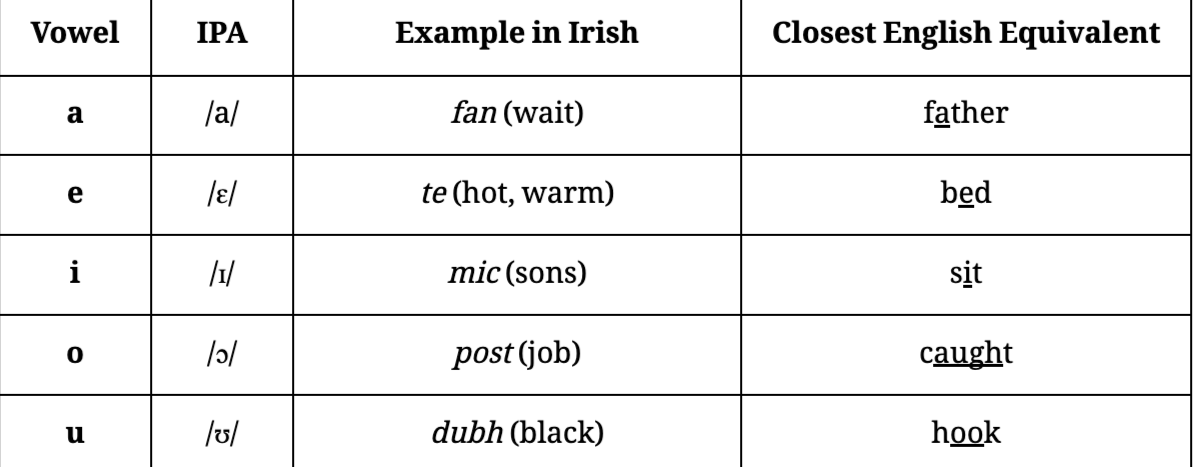
Vowels without a Fada
On the right you can find the pronunciation of the vowels without a fada.
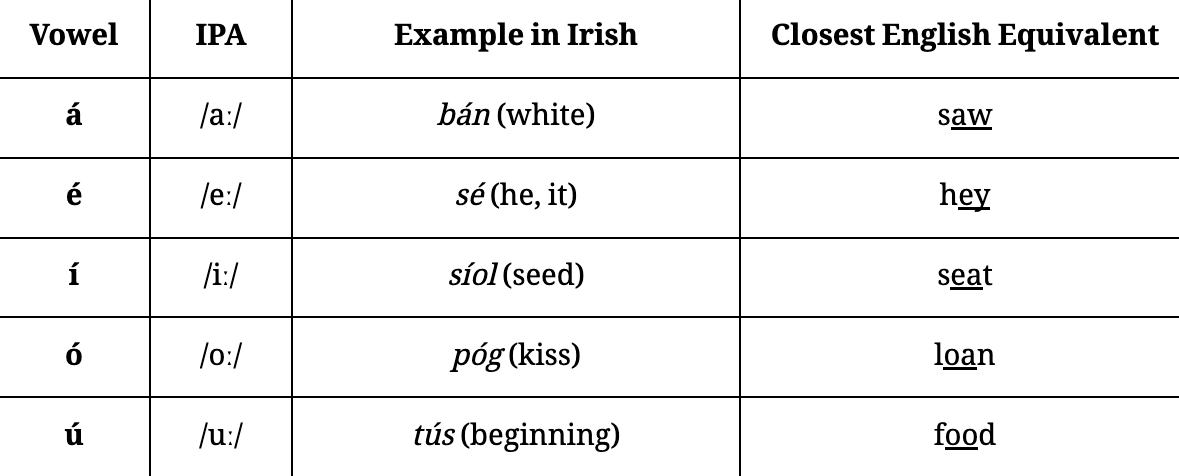
Vowels with a Fada
On the right you can find the pronunciation of the vowels with a fada.
Vowel Reduction
Just as in English, short vowels in Irish will be reduced to a schwa /ə/ when unstressed. Similar to how in English, the second e in the word telephone is reduced to an ‘uh’-ish sound.
Note that vowel reduction does not apply to vowels which carry the fada.
ólann /ˈoːlˠən̪ˠ/
“oh-lunn”
mála /ˈmˠaːlˠə/
“maw-luh”
seisean /ˈʃɛʃənˠ/
“sheh-shun”
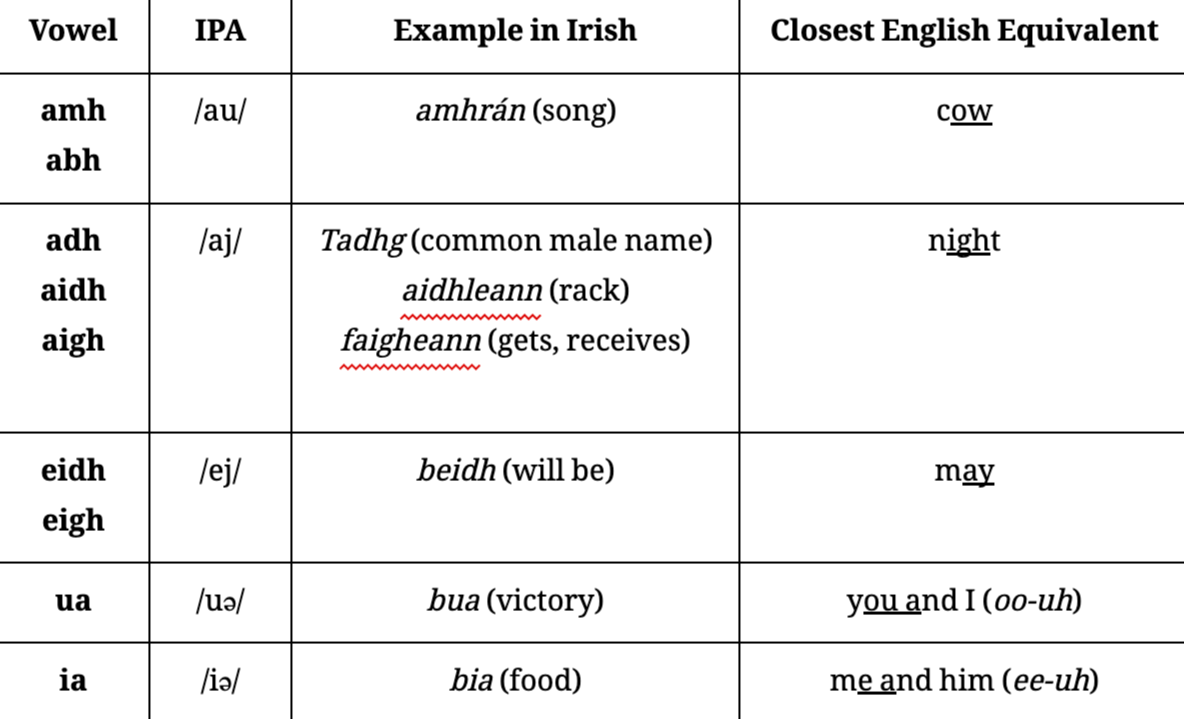
Diphthongs
Diphthongs refer to putting two vowel sounds together to create a new vowel sound. The number of diphthongs in Irish varies on dialect, but the generally accepted number found across dialects is five.
/aw/ ~ /əw/
/aj/ ~ /əj/
/ej/
/uə/
/iə/