Broad and Slender in Irish
In Irish, all consonants have two distinct pronounciations; broad and slender. This is affected by the closest vowel to the given consonant.
mana
‘mana’
/ˈmanə/
Áine
‘awnyeh’
/ˈaːnʲə/
However, in the name Áine, we can see that even though there are only three distinct sounds: aw - ny - eh (IPA: ˈaː - nʲ - ə). So, why don’t we use spell it ‘Áne’?
In Irish, we must always make sure that the vowels match to clarify the pronunciation of all the consonants in a given word. By spelling it like Áne, we are leaving the pronunciation of Áine unclear:
the á before the n is telling us it has a broad n pronunciation
the e after the n is telling us it has a slender ny pronunciation
By adding in the extra ‘i’ to the word, we aren’t adding an extra sound, but rather clarifiying that the n has a slender pronunciation. You can listen to both of these words being pronounced here.
Generally speaking, the difference between the broad and slender pronunciation is that the slender pronunciation will contain a slight ‘y’ sound. Compare the following words on the right (audio below):
lom
liom
/l̪ˠomˠ/ - ‘lum’
/lʲɔmˠ/ - ‘lyum’
tae
té
/t̪ˠeː/ - ‘tay’
/tʲeː/ ‘tyay’
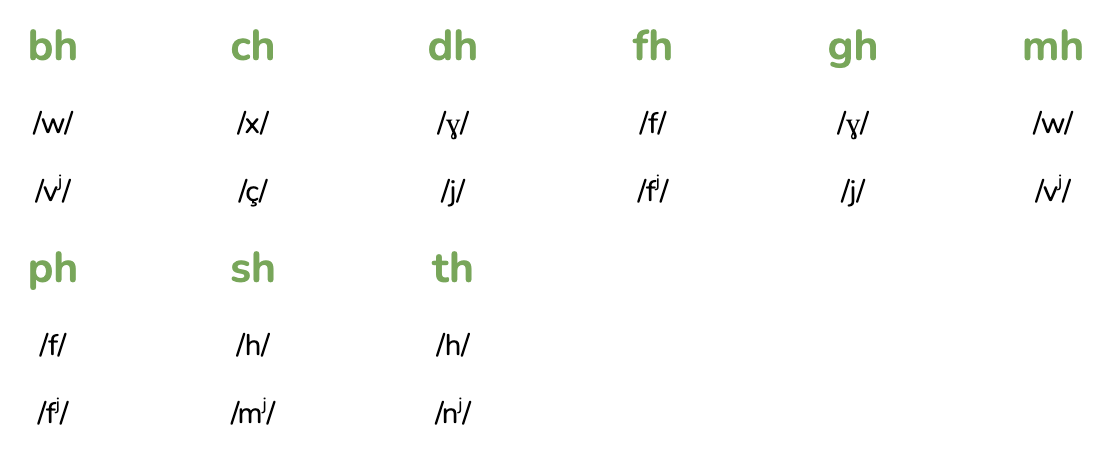
There are however, some consonants which will completely change pronunciation between the broad and slender.
Note that the slender r doesn’t appear at the beginning of words (and is always pronounced broad) but is kept here as an example.Y
You can hear a recording of each of the broad and slender pairs below: